News & Resources
IRAP shares newly released U.S. Citizenship and Immigration Services (USCIS) documents about the targeting of refugee communities in Minnesota – and beyond – through a USCIS program focused on reexamining refugee cases, known as Operation PARRIS. The documents confirm that 72 unadjusted Minnesotan refugees were targeted, arrested, and detained by ICE. The documents refer to Operation PARRIS’s “Minnesota Pilot” and a “model for additional vetting operations” and show that as of last October, there were 185,539 unadjusted refugees in the U.S. at risk of targeting as USCIS’s refugee revetting expands. IRAP obtained the documents through a Freedom of Information Act (FOIA) request.
Background
In early January 2026, the Department of Homeland Security (DHS) announced Operation PARRIS (Post-Admission Refugee Reverification and Integrity Strengthening), described as a “sweeping initiative” focusing on 5,600 refugees in Minnesota. According to the announcement, a new USCIS vetting center was spearheading the operation by reexamining refugee cases where the refugee had not yet adjusted his or her status to become a lawful permanent resident.
Earlier in November 2025, USCIS had issued a memorandum requiring revetting and potentially reinterview of all refugees admitted between January 21, 2021 and February 20, 2025, which includes over 200,000 individuals. Once Operation PARRIS began, Immigration and Customs Enforcement (ICE) arrested dozens of refugees in Minnesota and had transferred many of them to detention centers in Texas. The arrests continued until the district court in U.H.A. v. Bondi issued a Temporary Restraining Order (TRO) on January 28, 2026 that enjoined the government from arresting refugees in Minnesota on the basis that they have not yet adjusted status and ordered the government to release all refugees detained pursuant the mass arrest policies.
On February 18, 2026, the government issued a new national policy in a memorandum taking the position that DHS is required to locate, arrest, and detain refugees who do not apply for adjustment of status after a year and attend an interview. Together with Democracy Forward, IRAP challenged this national policy in a new lawsuit, Jean A. v. Noem, and on March 23, the court in Massachusetts stayed the government’s implementation of the national refugee detention policy. This means that, under the court’s order, the government cannot arrest refugees solely on the basis that they have not yet adjusted status. However, since Operation PARRIS began, USCIS has continued to target refugees for revetting and termination of refugee status.
IRAP’s FOIA Request and Litigation for Operation PARRIS Records
Recognizing the immediate, and likely expanding, consequences of such a fallacious and devastating federal policy, IRAP sought the expedited disclosure of the details of Operation Parris through Freedom of Information Act (FOIA) requests to USCIS, ICE, and DHS, filed March 25, 2026. On May 14, 2026, IRAP filed a lawsuit in the Southern District of New York challenging the agencies’ refusal to respond to the request.
In response to IRAP’s FOIA request and litigation, on August 24, 2026, USCIS produced 249 pages of documents along with data in multiple spreadsheets:
The data spreadsheets, available for download in their original format here, include data on: 1) refugee arrivals from 2015-2025 who have not been approved for lawful permanent residency, divided by country of citizenship and state of residence; 2) refugee arrivals in Minnesota from 2015-2026 who have not been approved for lawful permanent residency, divided by country of citizenship; 3) refugees arrested by ICE and detained as part of Operation PARRIS in Minnesota, divided by country of origin, “date of entry” (which may refer to entry in the spreadsheet), and case status; 4) a set of three reports on refugee and asylee I-485 filings and adjudications, with: i) a report on refugee and asylee I-485 adjudication data between April 1, 2025 and June 6, 2025; ii) a report on affirmative asylum I-485 filings as of June 6, 2025 organized by year of asylum grant and country of birth, for asylees granted affirmative asylum between Fiscal Year 2007 – June 6, 2024; and iii) a report on refugee I-485 filings as of June 6, 2025 for refugees admitted between Fiscal Year 2007 – June 6, 2024 organized by year of arrival and country of birth.
Operation PARRIS Revetting and Refugee Status Terminations Envisioned as a “Model”
The documents contain a number of internal memoranda, email correspondence regarding matters of the operations under PARRIS, and public affairs “talking points” on Operation PARRIS. Although most of the Operation PARRIS records are largely redacted, there are some insights into USCIS’s thinking and actions, as well as significant data on the impacts in Minnesota and risks to refugees around the country.
The collection of released documents corroborates what revetting operations consist of, with documents noting that reexamination includes re-doing background checks and re-verifying the merits of each cases’ underlying refugee claim. USCIS documents affirm that following case review, flagged unadjusted refugee cases are then determined for re-interviews, issuance of Notices of Intent to Terminate (NOIT), issuance of Notices to Appear (NTA), and/or referrals to ICE. The records contain a visual mapping the termination of refugee status process, embedded below:
From email correspondence, the role of the USCIS Office of Chief Counsel (OCC) and Office of Policy and Strategy in directing and overseeing Operation PARRIS is evident. Emails showing that OCC officials closely reviewed individual cases and in one instance, required sign-off on every one of twenty interviews scheduled for an upcoming week (embedded below). These offices report directly to the USCIS Director and are separate from the Refugee, Asylum, and International Operations (RAIO) Directorate that usually handles individual case adjudications. Their case reviews of some or, for the week in question, all cases may suggest higher-level involvement in individual cases outside of the regular chain of decision-making.
Released records verify USCIS’s intention to refine and expand Operation PARRIS as “a model for additional vetting operations, further reducing vulnerabilities by identifying those aliens who are present in the United States and are currently inadmissible, or were inadmissible at the time of entry.” Operation PARRIS initially focused its efforts within the refugee community in Minnesota; however, as the released records confirm, USCIS intends for Operation PARRIS to expand outside of Minnesota:
The Devastating Impact of Operation PARRIS in Minnesota, So Far
The released data records confirm the large, catastrophic reach of Operation PARRIS on refugee communities in Minnesota. As a part of Operation PARRIS’s initial efforts in Minnesota, USCIS identified nearly 5,600 refugees who had not adjusted their status to LPR after one year in the United States. The released records state that the operations of this pilot program are to continue “indefinitely,” until all targeted cases have been reviewed. Contained within the government files is a DHS data report dated October 22, 2025 revealing that of the approximately 5,948 refugees residing in the state of Minnesota roughly 5,578 had not received I-485 approvals within one year of their arrival date.
At Operation PARRIS’s outset, IRAP, along with MN-based legal service providers, bore witness to ICE arrests and detentions of many in the Minnesota refugee community. These government records show that prior to court orders blocking the detention of refugees on the basis of not being present after a year without having been granted adjustment of status, 72 unadjusted Minnesotan refugees were targeted, arrested, and detained by ICE. As the data on the released Excel sheet verifies, many of these 72 refugees were then transferred from ICE detention in Minnesota to centers in Texas, making it difficult to locate them and seriously inhibiting access to legal counsel.
The Intended Expansion of Operation PARRIS into other States
The released records also corroborate USCIS’s intention to expand the operations of refugee revetting through Operation PARRIS into other states, outside of Minnesota. According to the released DHS data, this potentially puts an estimated 185,539 unadjusted refugees across the United States at heightened risk of revetting pursuant to Operation PARRIS. As further detailed in the DHS summary report linked above, the largest unadjusted refugee populations in the United States are from the Democratic Republic of the Congo (42,244), Afghanistan (23,261), Syria (21,744), Venezuela (16,099), and Burma (14,080), followed by Somalia (7,891), Guatemala (7,777), and El Salvador (6,148), as visualized below:
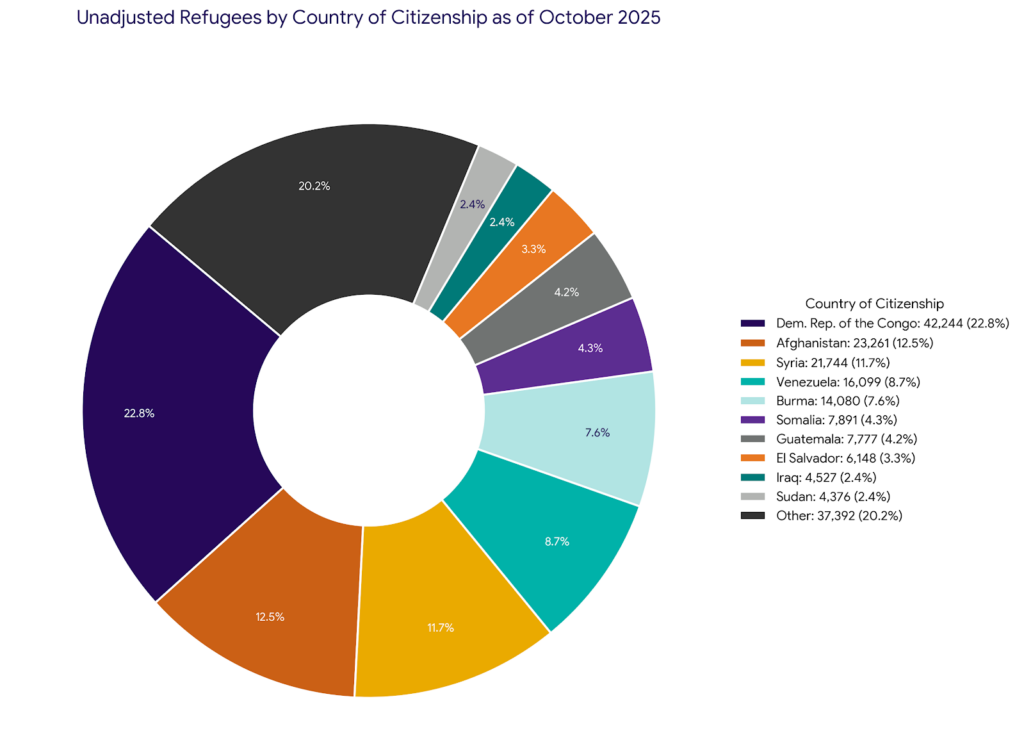
Chart created using data from USCIS report here
As detailed in our Toolkit on Refugee Revetting, IRAP is already aware of refugee adjustment of status interviews containing revetting questions, and the expansion of Operation PARRIS and its tactics to other refugee communities across the United States will have devastating consequences to not only the refugees targeted but also to their greater communities.
USCIS Training and Guidance on Refugee Adjustment of Status Adjudications
As part of the FOIA request, IRAP asked for USCIS’s training and guidance related to refugee adjustment of status. In the FOIA production, USCIS released its training slides on refugee I-485 eligibility, which date from October 2020, as well as a Refugee Adjustment Interview Criteria Checklist from October 2025, intended to be used when reviewing all refugee-based Form I-485s to determine if an interview is required. The checklist contains thirteen criteria already included in USCIS’s Policy Manual (#’s 1-13), as well as five additional criteria (#’s 14-19) that were not previously included in public materials. The training materials and other records have been added to IRAP’s searchable database of USRAP-related government documents released through FOIA.
Conclusion
As seen throughout the collection of released records, Operation PARRIS, along with the Trump Administration’s flawed justification behind its inception, has ripped apart refugee families and whole communities in Minnesota, subjecting refugees to a new, cryptic revetting process that carries serious, life-changing consequences. In short, Operation PARRIS is yet another example of the Trump Administration’s attack on refugees, all of whom went through rigorous background checks and vetting prior to being granted resettlement to the United States. Operation PARRIS has done nothing but stoke fear and uncertainty within refugee communities, populations that were promised protection by the U.S. government based on persecution in their country of origin. Despite the Trump administration’s attacks on refugees as well as other immigrants, including systematically dismantling legal immigration pathways and humanitarian protections as well as mass de-documentation efforts, IRAP stands to uphold the rights and dignity of people seeking safety. IRAP continues to fight so that everyone can have a safe place to live and a safe way to get there.
Written by Sara K. French, a Senior Staff Attorney in IRAP’s U.S. Legal Services Department.
The full collection of records is available here with original spreadsheet data available here.
The “background” section of this post was taken in part from IRAP’s Explainer on DHS’s Mass Arrests, Detention, and Revetting of Refugees. The chart above was created using an AI tool using on data from the FOIA request.
This blog post is intended for a legal practitioner and legal advocacy audience; it is provided for informational purposes only and does not constitute attorney-client advice. To find resources about immigration pathways in multiple languages, or to request help from IRAP, please use IRAP’s Legal Information website.
If you would like to receive email alerts about IRAP’s legal practitioner resources, please sign up here.
This publication is from October 2026. It is not being updated and does not reflect legal changes since publication. Please see IRAP’s Legal Practitioner Resources page for additional information for legal practitioners.